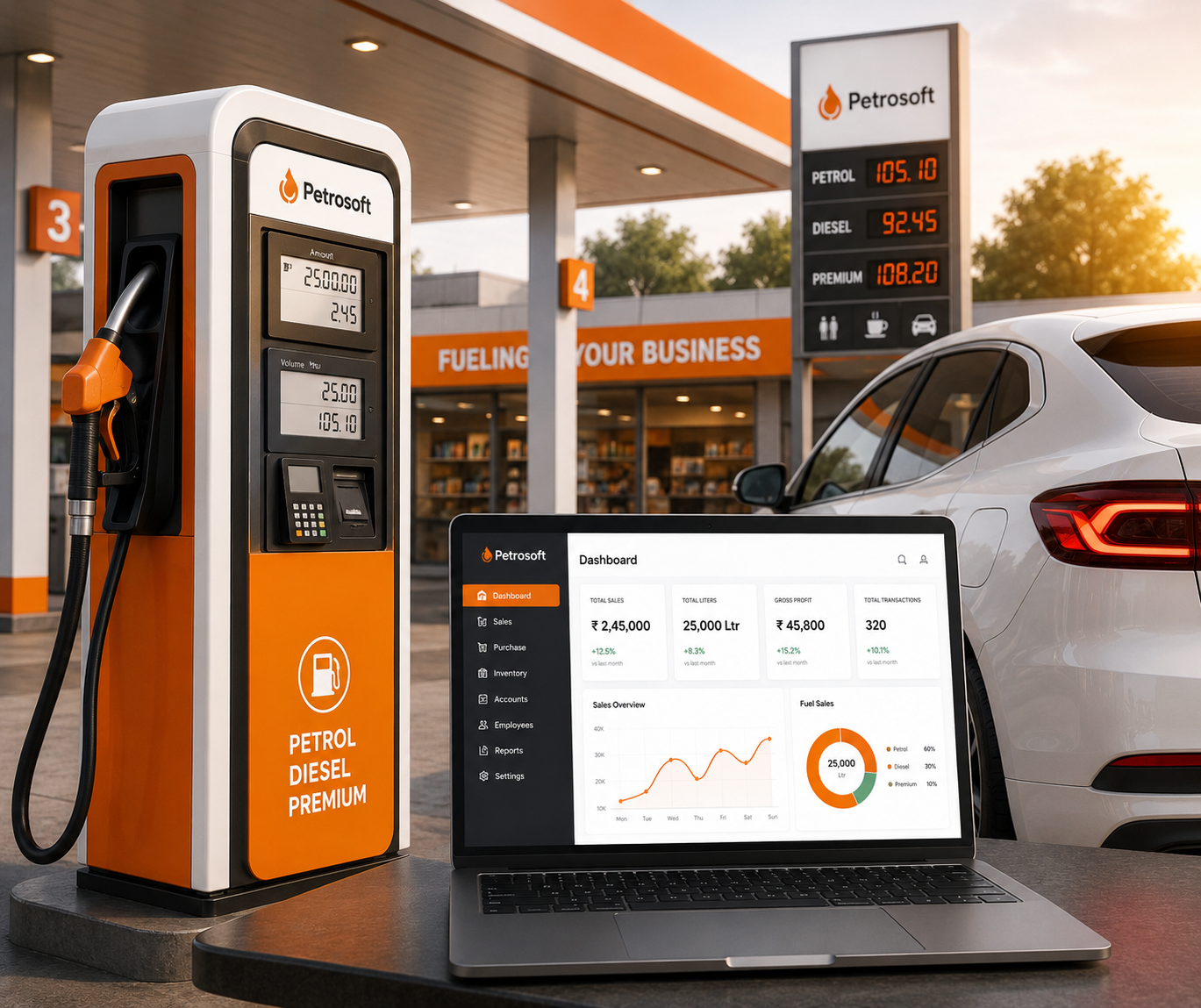

Managing a modern petrol pump involves more than selling petrol and diesel. Dealers need visibility into sales, fuel stock, transactions, shifts, employees, credit customers, expenses, collections, and daily business performance.
For HPCL dealers, many retail outlet activities are already supported by a highly automated retail environment. HPCL states that its retail outlets are connected to its Central Head Office system, with outlet transactions captured locally and transferred for monitoring. HPCL also uses automation for fuel dispensing, inventory visibility, pricing, payment integration, and operational controls.
The important question for dealers is therefore not whether the petrol pump should be automated. It is how to organize the operational information and dealer-level business activities around that automated environment.
What Is HPCL Petrol Pump Automation?
HPCL petrol pump automation uses digital systems to monitor and manage important retail outlet activities.
According to HPCL, its retail automation connects outlets with the company's central system. Outlet transactions are captured and transferred to the central server, allowing activities to be monitored. HPCL also states that its automation provides access to sales volume, transaction data, and inventory information in real time.
In practical terms, automation helps reduce unnecessary manual intervention at the fuel station and improves the visibility of operational information.
What Does HPCL Retail Automation Capture?
Depending on the systems and processes used at the outlet, automation can support information related to:
- Fuel sales and transactions
- Fuel dispensing activity
- Fuel inventory
- Tank and dispenser information
- Pricing
- Payment transactions
- Operational conditions
- Retail outlet performance
- Central monitoring and reporting
HPCL also uses integrated payment systems so that fueling information can flow automatically to the payment terminal, supporting its "what is filled is billed" approach.
How Does HPCL Retail Automation Work?
A simplified view of the process is:
Customer Fuelling → Fuel Dispenser → Transaction Recorded → Retail Outlet Automation → HPCL Central System → Monitoring & Analytics
The automation system captures information generated during retail operations and transfers relevant data to HPCL's central system.
HPCL says its Central Head Office System provides real-time visibility into sales volume, transaction data and inventory management. It also provides role-based access to stakeholders, including dealers, for remote monitoring of outlet operations.
This creates a more connected operating environment than traditional manual record-keeping.
What Does HPCL Automation Mean for Petrol Pump Dealers?
For a dealer, automation can provide several operational advantages.
1. Better Visibility into Sales
Fuel sales generate a large amount of transaction data every day. Automated systems help capture this information digitally, making it easier to monitor outlet activity and understand sales performance.
2. Better Transaction Tracking
Automated transaction capture reduces dependence on manually recording every fueling transaction. This can improve transparency and make operational information easier to review.
3. Better Inventory Visibility
Fuel inventory is one of the most important areas of petrol pump management. HPCL states that its retail automation and Central HOS provide real-time access to inventory management information.
4. Faster Access to Operational Information
Instead of depending entirely on physical registers or manually collected information, digital systems can make important outlet information available faster.
5. More Focus on Business Management
When routine operational information is captured digitally, dealers and managers can spend more time reviewing performance, controlling expenses, managing customers, and making business decisions.
What HPCL Automation Does Not Replace for Dealers
Retail automation and dealer business management are related, but they are not exactly the same thing.
HPCL's automation focuses strongly on retail outlet operations, transaction capture, fuel monitoring, inventory visibility, payment integration and centralized monitoring.
However, a petrol pump dealer may also need to organize broader business activities such as:
- Employee records and attendance
- Payroll management
- Credit customer management
- Customer outstanding tracking
- Expense management
- Vendor transactions
- Business-level reporting
- Cash and bank monitoring
- Management analysis
- Multi-outlet business monitoring
The exact systems and responsibilities can vary by dealership. Therefore, dealers should look at retail automation and dealer-level business management as complementary areas, rather than treating one as a complete replacement for the other.
HPCL Petrol Pump Data: What Should Dealers Monitor?
Having access to information is only useful when that information is regularly reviewed.
| Area | What Dealers Should Monitor |
|---|---|
| Fuel Sales | Petrol and diesel sales volume |
| Transactions | Daily transaction activity |
| Fuel Stock | Opening stock, receipts, sales and closing stock |
| Shift Activity | Shift-wise sales and collections |
| Payments | Cash, card, UPI and other collections |
| Credit | Customer balances and outstanding amounts |
| Employees | Attendance, shifts and payroll information |
| Expenses | Daily operating expenses |
| Vendors | Purchases and vendor transactions |
| Reports | Daily, weekly and monthly performance |
| Stock Variation | Expected vs actual stock |
| Management | Overall business performance |
A connected view of these areas helps the dealer move from simply recording transactions to actively managing the business.
HPCL Retail Automation vs Dealer Business Management
| HPCL Retail Automation | Dealer Business Management |
|---|---|
| Fuel transaction data | Business-level reporting |
| Dispenser-related information | Employee management |
| Sales information | Credit customer management |
| Fuel inventory information | Expense management |
| Central monitoring | Cash and bank management |
| Automated retail processes | Owner-level business analysis |
| Payment integration | Multi-outlet management |
How Petrol Pump Management Software Supports Dealer-Level Operations
Petrol pump management software can help organize the business activities that dealers and managers need to monitor beyond the core retail automation environment.
Depending on the software and configuration, this can include:
- Fuel inventory monitoring
- Sales management
- Shift-wise transactions
- Employee attendance
- Payroll management
- Credit customer management
- Customer outstanding tracking
- Expense monitoring
- Cash and bank transactions
- Business reports
- Management dashboards
- Mobile access to business information
The purpose is not to replace HPCL's retail automation system. Instead, dealer-management software can provide an additional business-management layer for activities that the dealer needs to track and analyze.
How Petrosoft Can Help HPCL Petrol Pump Dealers
Petrosoft is designed to help petrol pump owners and managers organize key dealer-level business activities through a centralized management system.
Its capabilities include areas such as:
- Fuel inventory management
- Sales monitoring
- Shift-wise transactions
- Credit customer management
- Employee and payroll management
- Cash and bank transactions
- Business reports
- Mobile access and monitoring
For an HPCL dealer, the value of such software is in bringing dealer-level business information into a structured management environment.
It should not be considered an official HPCL system or an indication of direct integration with HPCL's central systems unless such integration has been specifically confirmed.

Manual Dealer Management vs Connected Business Management
| Business Area | Manual Management | Connected Management |
|---|---|---|
| Sales | Multiple records | Centralized information |
| Stock | Manual tracking | Digital stock monitoring |
| Shifts | Registers and spreadsheets | Shift-wise digital records |
| Credit | Manual outstanding lists | Centralized customer balances |
| Employees | Separate attendance records | Attendance and payroll management |
| Expenses | Manual entries | Organized expense records |
| Reports | Time-consuming preparation | Faster report generation |
| Owner Monitoring | Requires physical follow-up | Remote access to business information |
The goal is not simply to eliminate paperwork. The bigger advantage is better visibility and faster decision-making.
What Should an HPCL Petrol Pump Dealer Check Every Day?
A daily review can help identify operational or financial issues before they become larger problems.
Daily HPCL Petrol Pump Checklist
- Review previous-day petrol and diesel sales.
- Check fuel stock and stock movement.
- Review shift-wise transactions.
- Verify cash collections.
- Check digital payment collections.
- Review credit customer transactions.
- Check outstanding customer balances.
- Verify employee attendance and shift allocation.
- Review daily expenses.
- Check vendor-related transactions.
- Review stock variations or unusual differences.
- Generate and review the daily management report.
A consistent checklist gives the dealer a clearer picture of how the outlet performed each day.
Final Thoughts
HPCL has built a highly automated retail environment that provides centralized visibility into important petrol pump operations. Its automation supports transaction capture, fuel monitoring, inventory visibility, payment integration and operational control.
For dealers, the next step is to organize the broader business information generated around daily operations.
HPCL retail automation manages the operational environment. Dealer-level management helps turn business information into better decisions.
For petrol pump owners looking to bring sales, inventory, shifts, credit, employees, expenses and reports into a connected management environment, petrol pump management software can provide an additional layer of business control.